“Mason has excellent workmanship, communication, knowledge, and experience with Google Ads. He has understood our market and fine tuned our ads that have generated above expectations in results. We highly recommend his services!”
If your business isn’t appearing in the top 3 results on Google Maps, you’re losing calls every day to competitors who aren’t necessarily better than you, only more visible. That visibility doesn’t come from a one-time fix. It compounds over time, built from two things most businesses neglect: a steady stream of genuine reviews, and visible proof of the work you actually complete. Here’s how Google Maps ranking actually works, and the practical steps that build both.
How Google decides which local businesses appear
Google has published the framework it uses to rank local businesses. It comes down to three factors.
Relevance
How closely your business profile matches what someone searched for.
Distance
How close your business is to the searcher or the location they searched. This isn’t something a business can normally control.
Prominence
How established and well known your business appears, including your reviews and the information about you found across the web.
You can’t change how far away you are from a searcher. What you can do is improve the quality, consistency, and amount of evidence surrounding your services and the work you’ve completed, which is what the rest of this article is about.
What actually determines your Google Maps ranking
Google uses several signals to decide who shows up in the top 3. Most local businesses get only one or two of these right. The businesses dominating your area are getting all of them right consistently.
1. Review velocity
Not just the number of reviews you have, but how regularly new ones are coming in. A business with 50 reviews all from three years ago ranks lower than a business with 30 reviews collected consistently over the last six months.
Google interprets regular new reviews as a signal that the business is active, trusted, and serving customers right now.
2. Google Business Profile activity
Your GBP profile needs regular activity to signal to Google that you’re an active business. Photos of recent jobs, posts about services, updated business information. Most businesses set up their profile once and never touch it again.
3. Geo-location signals
This is the one most businesses have never heard of. Consistent evidence that your business is physically completing jobs across your service area can support prominence and strengthens the information surrounding your business.
The businesses ranking for “plumber in Leeds” usually aren’t just optimised for that keyword. They’ve built up a visible record of jobs completed in Leeds, repeatedly, over time.
4. Proximity and relevance
Google considers how close the business is to the searcher and how relevant the profile is to the specific search term. You can’t move your business address but you can significantly improve relevance through profile optimisation.
5. Consistency of information
Your business name, address, and phone number needs to be identical everywhere it appears online. Inconsistencies confuse Google and lower your ranking. This is a small fix that has a measurable impact.
The compound effect
Here’s what most guides don’t tell you. These signals compound.
More geo-location signals lead to higher ranking. Higher ranking leads to more profile views. More profile views lead to more calls. More calls lead to more jobs. More jobs lead to more opportunities to collect reviews. More reviews lead to higher ranking.
Once the cycle starts it accelerates on its own. The problem is most businesses never start it.
Jobs completed
→
Geo signals posted
→
Ranking climbs
→
More calls
→
More reviews
The compounding cycle. Once it starts, it builds on itself. The businesses in the top 3 didn’t get there overnight. They started the cycle earlier than you.
Two forms of evidence most local businesses underuse
Think about all the jobs your business completed over the last year. Apart from a handful of Google reviews and a few social posts, most of that work probably left very little lasting evidence online.
There are two forms of evidence that can support prominence, and most local businesses only build one of them.
Reviews
Reviews show that customers trust your business. They influence whether someone clicks through to you, and a steady flow of new reviews can support prominence over time. A simple way to collect more of them is the Google Review Card, a tap-to-review NFC card you hand a customer right after a job so they can leave a review in seconds.
Completed-job evidence
Fusion44 is designed to change that. Instead of treating each completed job as a one-off update, the app records it as a geo pin and adds it to a growing body of search engine‑visible evidence: completed-job records, job photographs, the service performed, its location or service-area context, dates and descriptions, all published to a searchable local business directory (with an optional plugin to add job pins to your own website) so it’s publicly accessible information search engines can discover. Over time, you can track how your local visibility changes as that record grows.
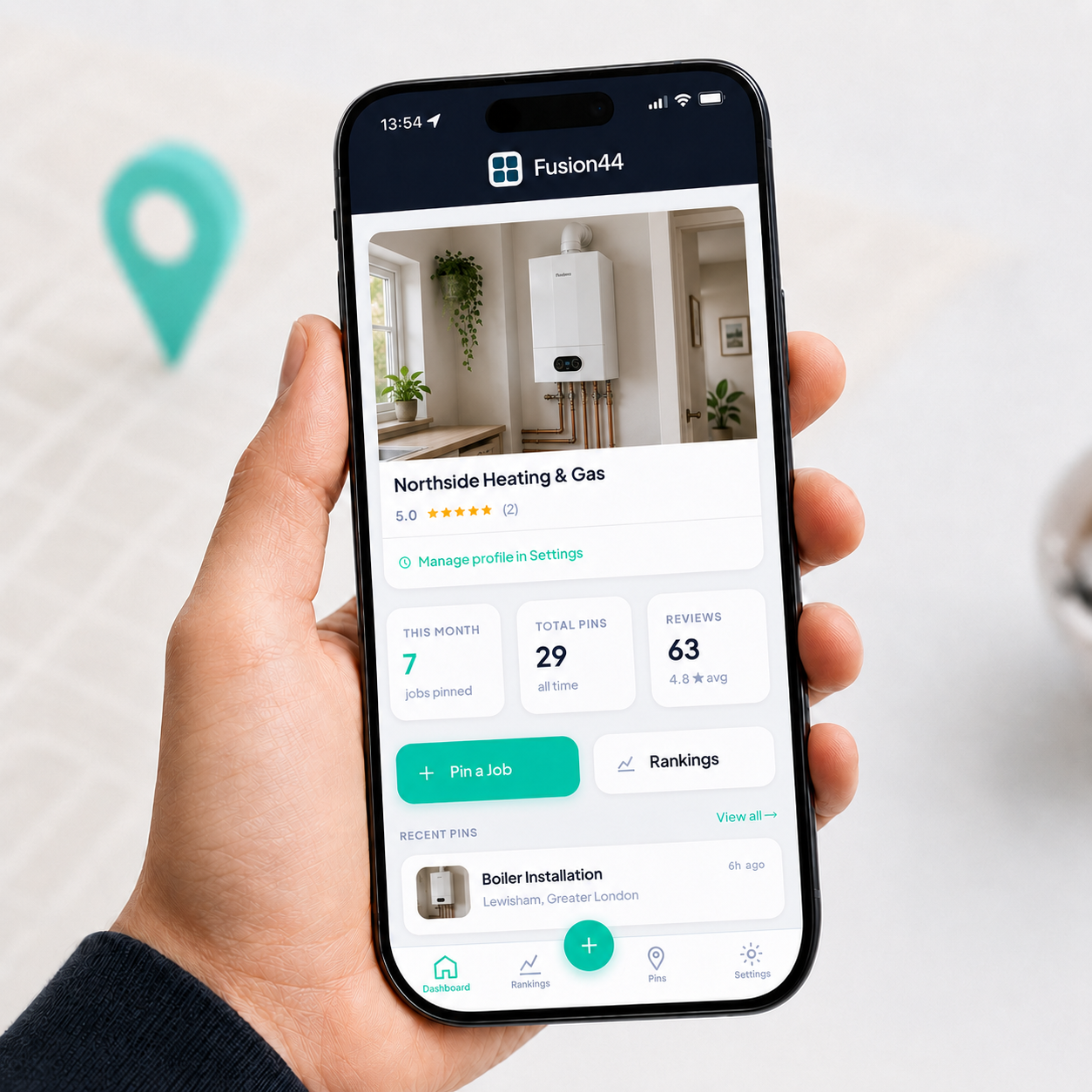
Fusion44 helps service businesses record completed work, organise job evidence and build a growing record of activity across the areas they serve.
Why Google Maps matters more than your website
When someone searches “plumber near me” or “dentist near me” they don’t scroll through websites. They look at the map pack: the three listings that appear at the top of the results page.
Those three businesses get approximately 90% of the calls from that search.
Everyone below position 3 is competing for the remaining 10%.
Your website, your social media, your years of experience, none of it matters if you’re not in that top 3. Customers call who they see first.
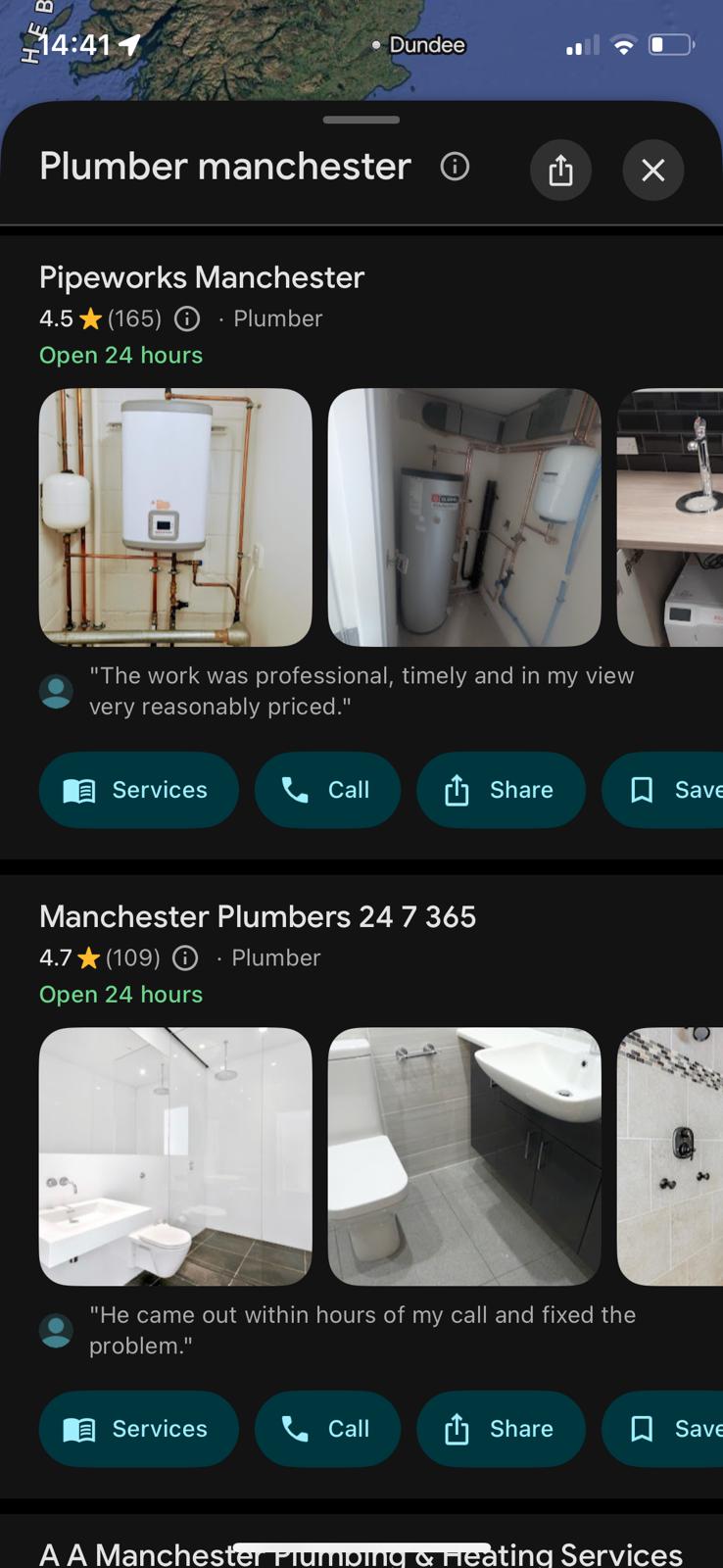
The top 3 positions capture the overwhelming majority of calls. Position 4 onwards is fighting over scraps.
If you’re a plumber, electrician, roofer, cleaner or other local service business…
This gap shows up more often in trades than almost anywhere else. Most service businesses do real, visible work every single day, but they consistently miss the two things that would show that work to Google and to customers:
- They finish a job and move straight on to the next one without asking for a review
- They rarely document the completed job in a way that builds a lasting, public record
- They miss out on the local evidence that more consistently active competitors are quietly building up
Neither of these takes long to fix. They just need to become part of how every job ends.
How to start building your Google Maps ranking today
01
Claim and complete your Google Business Profile
If you haven’t claimed your profile do that first at business.google.com. Once claimed fill in every section completely: services, service area, business hours, photos, business description.
02
Start collecting reviews systematically
After every completed job, present the Google Review Card and ask the customer to tap it and leave a Google review. Not a generic request. A direct, one-tap route to your review page. Most customers who are happy will leave a review if you make it this easy. Most businesses never ask.
03
Post job photos to your profile regularly
Every job you complete is an opportunity to post a photo to your GBP. This shows consistent activity and keeps your profile fresh. Two or three posts per week makes a measurable difference within 60–90 days.
04
Document completed work across your service area
Every job you complete is an opportunity to add to your public record of work. Fusion44 is built for exactly this: record the job, and it builds that evidence for you over time.
05
Accelerate your enquiries with Google Ads
Generate qualified enquiries immediately while your Google Maps presence continues to grow over time. Google Ads puts your business at the top of search results in front of people actively searching for your services today, giving you a predictable source of leads while your organic visibility compounds.